Important Cultural Property Buildings, Buildings from the Meiji Period
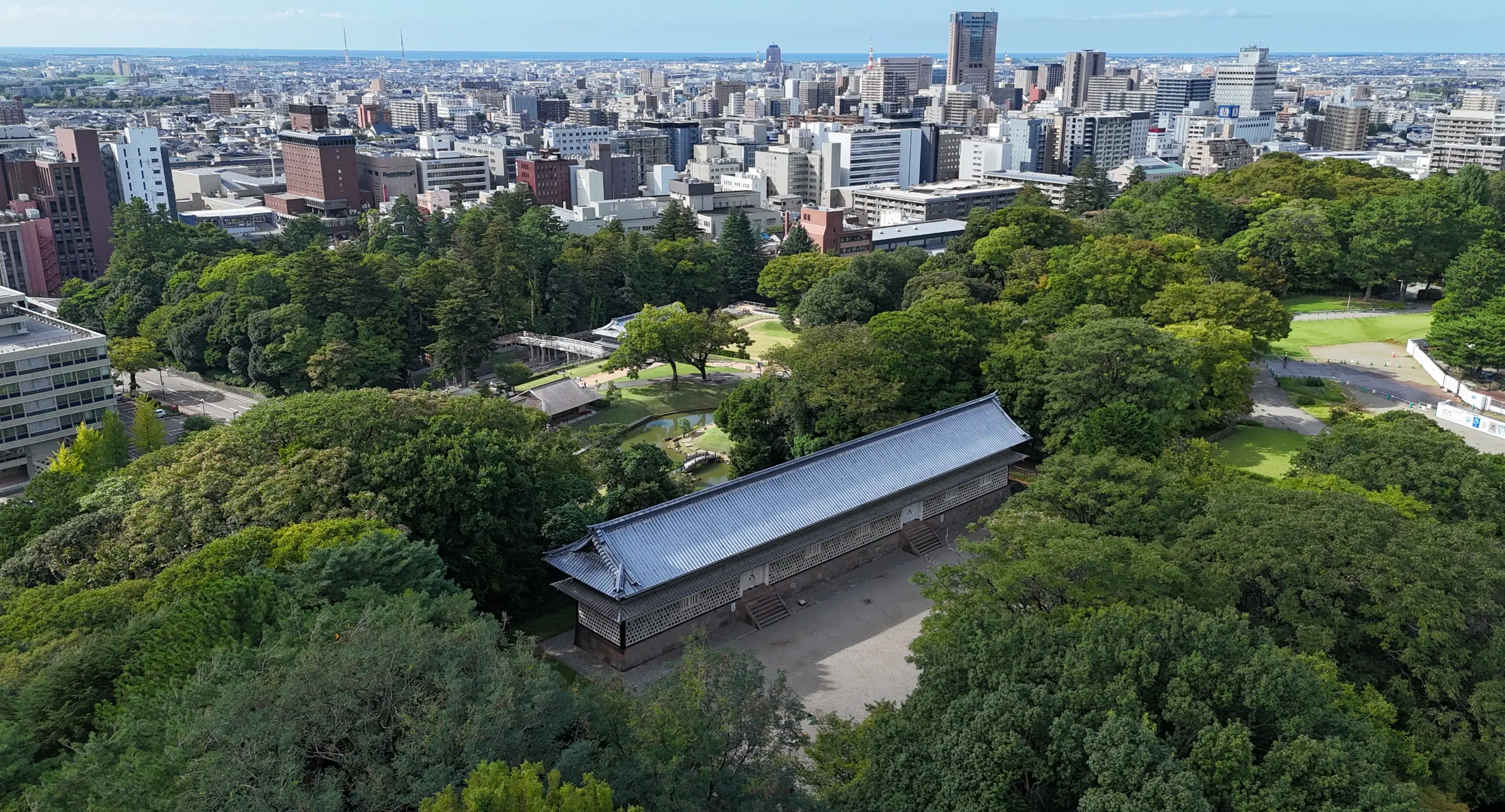
Kanazawa Castle Park preserves three buildings dating from the Edo period, all of which are designated as Important Cultural Properties of Japan.
The Ishikawa-mon Gate and the Sanjikken-nagaya Storehouse feature characteristic elements of Kanazawa Castle’s architecture: roofs covered with lead tiles, white plastered walls, and namako‑kabe lower walls. The storehouse (Tsurumaru Storehouse) is an elegant structure distinguished by its gray‑green tuff stone applied on the lower wall section. As one of the largest surviving storehouses within a Japanese castle complex, it is considered an invaluable historical asset.
In addition, stone artifacts that convey the history of Kanazawa Castle—such as the stone conduits of the Tatsumi Waterway and stone well frames once buried on the castle grounds—are now displayed. Furthermore, the former Headquarters Building of the Sixth Army Brigade, constructed during the Meiji period, still remains within the castle precincts. It is preserved as a structure that reflects the layered history of Kanazawa Castle.
The Ishikawa-mon Gate and the Sanjikken-nagaya Storehouse feature characteristic elements of Kanazawa Castle’s architecture: roofs covered with lead tiles, white plastered walls, and namako‑kabe lower walls. The storehouse (Tsurumaru Storehouse) is an elegant structure distinguished by its gray‑green tuff stone applied on the lower wall section. As one of the largest surviving storehouses within a Japanese castle complex, it is considered an invaluable historical asset.
In addition, stone artifacts that convey the history of Kanazawa Castle—such as the stone conduits of the Tatsumi Waterway and stone well frames once buried on the castle grounds—are now displayed. Furthermore, the former Headquarters Building of the Sixth Army Brigade, constructed during the Meiji period, still remains within the castle precincts. It is preserved as a structure that reflects the layered history of Kanazawa Castle.