Changes in the Castle Layout
Before Kanazawa became an early modern castle town, this site is believed to have been the location where, in 1546 (Tenbun 15), Honganji’s 10th abbot, Shōnyo, established the Kanazawa MIdo as a branch temple overseeing the Kaga Ikko‑ikki. Although it is traditionally said that the Mido was located near the present Honmaru area, no definitive evidence has been found.
Transformation into an Early Modern Castle
The development of Kanazawa Castle as an early modern fortress underwent major changes marked by three great fires: the fire of 1631 (Kan’ei 8), the fire of 1759 (Hōreki 9), and the fire of 1808 (Bunka 5).
Through the process of reconstruction, the castle evolved in several phases:
Early Kanazawa Castle: from 1580 (Tenshō 8) until the Kan’ei fire
First Phase (Early Modern): from the Kan’ei fire until the Hōreki fire
Middle Phase: from the Hōreki fire until the Bunka fire
Late Phase: from the Bunka fire until the abolition of feudal domains (1871)
Early Kanazawa Castle
In 1580 (Tenshō 8), Shibata Katsuie, the Oda clan’s lord of Echizen Province, captured the Kanazawa Gobo. His nephew, Sakuma Morimasa, became the first lord of Kanazawa Castle and began developing the fortress.
It is presumed that this early work consisted mainly of earthen embankments and moats, but the details remain unknown.
After the Battle of Shizugatake in 1583 (Tenshō 11), Maeda Toshiie—who had sided with Toyotomi Hideyoshi—moved from Nanao Castle in Noto to become lord of Kanazawa Castle. He carried out major construction projects such as building the tenshu (main keep) between 1586 and 1587 (Tenshō 14–15) and constructing the tall stone walls of the Honmaru in 1592 (Bunroku 1).
Subsequently, under the second lord, Maeda Toshinaga, and the third lord, Maeda Toshitsune, full‑scale development of Kanazawa Castle and the surrounding castle town progressed. Major projects included the construction of the uchi‑sōgamae (inner defensive perimeter) in 1601 (Keichō 6) and the soto‑sōgamae (outer defensive perimeter) in 1610 (Keichō 15).
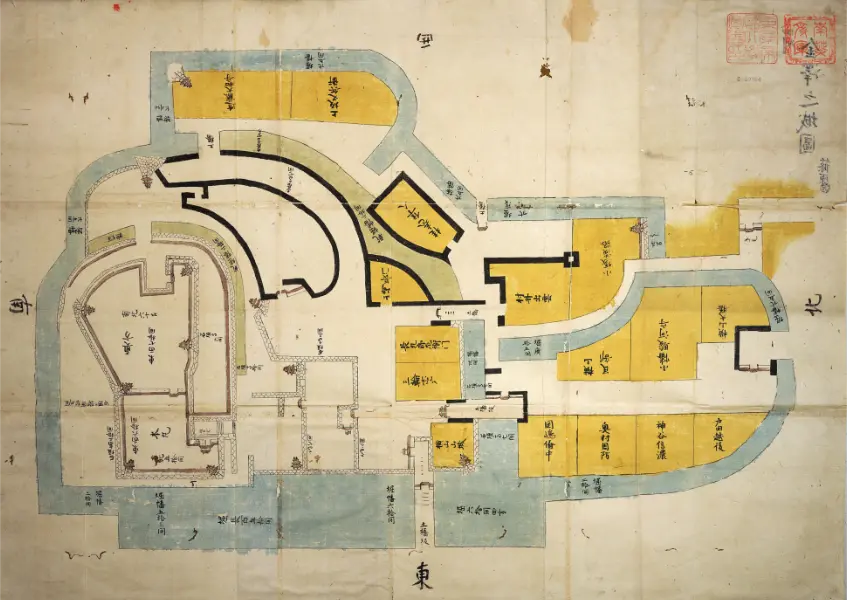
初期金沢城の絵図・本丸を中心とした縄張り 「加州金沢之城図」(東京大学総合図書館蔵)
Early Modern Kanazawa Castle – Early Phase
In April 1631 (Kan’ei 8), a fire broke out in the castle town and spread to the central facilities of the castle, including the Honmaru Palace. After this disaster, due to the limited space on the Honmaru plateau, the Ninomaru was expanded and the Ninomaru Palace was newly constructed. From that point onward, the Ninomaru served as the core area of the castle. At the same time, the three‑story turret and palace buildings in the Honmaru were also rebuilt.
The reconstruction undertaken by the third lord, Maeda Toshitsune, was enormous in scale, as evidenced by the remaining Kan’ei‑period stone walls throughout the castle and the massive mobilization of laborers from across the domain. This large‑scale project even led the shogunate to suspect Toshitsune of plotting rebellion.
The castle layout visible today was established largely through the reconstruction works carried out after the Kan’ei fire. The castle precincts were roughly defined by four outer Ōte‑bori Moat, Imori‑bori Moat, Renchi‑bori Moat, and Hakuchō‑bori—enclosing an area approximately 500 meters east to west (from the Ishikawa Bridge to Gyokusen’inmaru), 760 meters north to south (from Kurumabashi to Tōuemon‑maru), and totaling about 30 hectares.
Beyond the outer moats, related facilities such as the Kanaya Demaru (near present‑day Oyama Shrine), Kenrokuen Garden, and Dōgata were also arranged.
In 1632 (Kan’ei 9), the Tatsumi Waterway (a nationally designated historic site) was excavated, bringing a plentiful supply of water into the castle from its intake point upstream at Tatsumi‑mura on the Saigawa River.
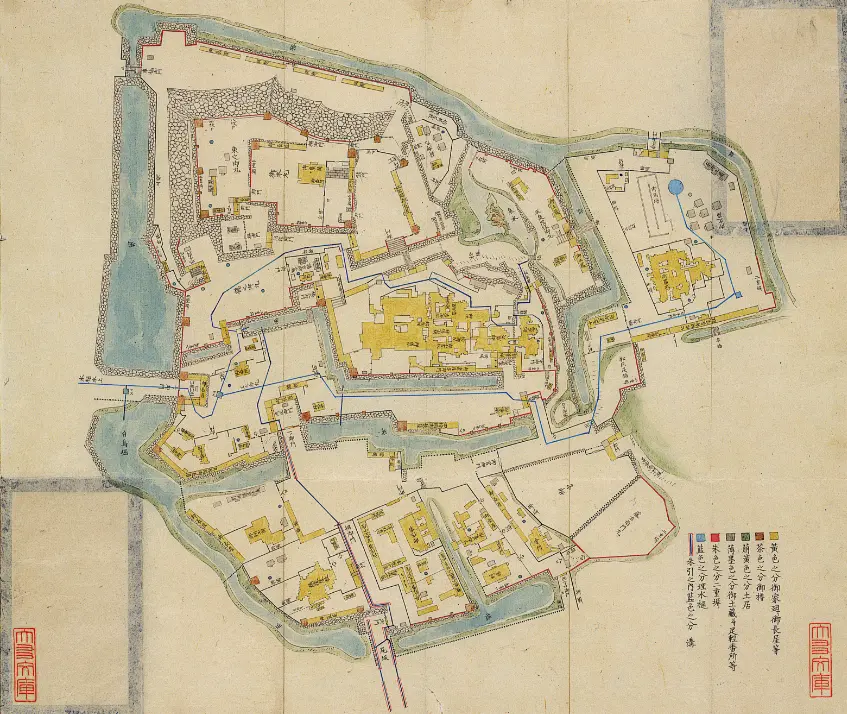
前期金沢城の絵図・概ね現在の縄張りが形成される 「金沢城図」(金沢市立玉川図書館蔵)

前期二の丸御殿の絵図・前田利常が創建した御殿 「金沢城二之丸座舗之図」(部分)(金沢市立玉川図書館蔵
Middle Phase of Kanazawa Castle
In April 1759 (Hōreki 9), the castle town was struck by an unprecedented conflagration that destroyed more than ten thousand samurai residences, temples, and townhouses. Kanazawa Castle also suffered catastrophic damage: the Honmaru, Ninomaru, Sannomaru, and other major facilities were completely burned down. The extent of the destruction can be seen in an illustration submitted to the shogunate requesting permission for the castle’s reconstruction and stone wall repairs, which marks 142 damaged locations.
In the following year, reconstruction began, starting with buildings such as the Ura-Shikidai of the Ninomaru Palace, along with repairs to the stone walls. The present‑day Ishikawa Gate is the one rebuilt after the Hōreki fire, completed in 1788 (Tenmei 8).
Due to severe financial constraints, however, some structures—including the group of turrets in the Honmaru and the grand audience hall and front Noh stage of the Ninomaru Palace—were never rebuilt.

中期二の丸御殿の絵図・竹の間や表能舞台は再建されなかった 「二之丸御殿并御広式御絵図」(金沢市立玉川図書館蔵)
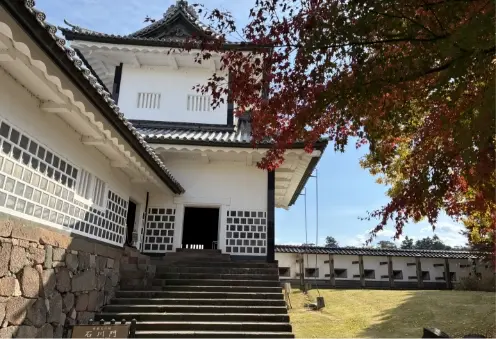
Ishikawa-mon Gate
Late Phase of Kanazawa Castle
In January 1808 (Bunka 5), a fire broke out in the Ninomaru Palace, completely destroying the palace and other structures within the Ninomaru. Despite the domain’s grave financial difficulties, reconstruction was carried out over a period of three years, supported by monetary donations and material contributions from retainers and local residents.
The Sanjikken Nagaya, which still stands today on the Honmaru lower terrace, was rebuilt in 1858 (Ansei 5), nearly one hundred years after it had been lost in the Hōreki fire.
Additionally, the surviving storehouse on the Higashi‑no‑maru terrace (the present Tsurumaru Storehouse) was originally rebuilt after the Hōreki fire but was later reconstructed again in 1848 (Kaei 1).

後期金沢城の絵図 「御城中壱分碁絵図」(横山隆昭家蔵)

後期二の丸御殿の絵図・竹の間が再建される大規模な建物となった 「二の御丸惣絵図(三歩碁)」(金沢大学附属図書館蔵)

Sanjikken-nagaya Storehouse

Tsurumaru Storehouse