Reconstruction of Kanazawa Castle
Gyokusen'inmaru Garden, Gyokusen-an Rest Area
Gyokusen'inmaru Garden — A Garden Cherished by Generations of Maeda Lords, Recreated as It Once Appeared

Characteristics of the Garden and Overview of the Restoration
Overall Site Development Plan of Gyokuseninmaru Garden

Highlights Within the Garden
Shikishitanzaku-zumi Stone Wall
This special stone wall incorporates a waterfall into its upper section.
At the waterfall’s mouth, a V-shaped stone spout made of dark Tsubono stone is installed, and square (shikishi) stones and long rectangular (tanzaku) Tomuro stones are arranged in staggered patterns.
This is considered a masterpiece unique to Kanazawa Castle, skillfully integrating castle stonewall engineering with refined garden aesthetics.

Stepped Waterfall
Archaeological investigations confirmed the remains of a waterfall flowing down a slope in four stages.
To preserve the remains, the area was covered with protective soil, and the waterfall was reconstructed above it using stone arrangements based on those found in the excavation.

Excavated waterfall remains / the reconstructed waterfall
Plantings and Landscape Stones
Based on old paintings, plantings are centered around pine trees cultivated within Ishikawa Prefecture.
Landscape stones sourced from within the prefecture were placed throughout the garden according to the drawings and findings from archaeological investigations.
Stone Wall Groups
The stone walls facing the garden retain their Edo-period form and were designed as “display stone walls,” featuring distinctive shapes, colors, and refined visual details.
They serve as a defining element of the garden’s character.

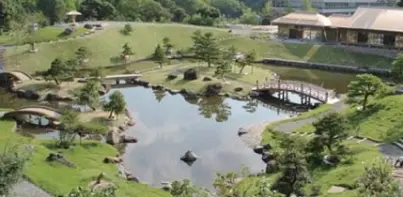
Garden Pond
The basic landform of the garden—such as the peninsula, pond, and islands south of Momiji Bridge—was restored based on archaeological findings, old paintings, and other materials.
Three islands of varying sizes were arranged to create shifting perspectives and a sense of depth depending on the viewing point.
During the Edo period, water for the pond was supplied by the Tatsumi Waterway drawn up to the Ninomaru, but in the restoration, water is pumped from the Imori Moat Tatsumi Waterway.
Stone materials for the bank protection, as well as the wooden, stone, and earth bridges, were sourced from within Ishikawa Prefecture.

Construction Outline
| Area | Approx. 1 ha (main garden area: 0.7 ha) |
|---|---|
| Pond works | 3 islets, bottom graveling (Surface area: approx. 1,400 m2, average depth: 0.6 m) |
| Waterfall works | Reconstruction of four-step waterfall based on excavation surveys (Height difference: approx. 7 m) |
| Water source | Pumped into the pond from Imori Moat (up to 1 ton/min) |
| Shore reinforcement | Stone arrangement (Tomuro stone; andesite from Noto), wooden pile, stone masonry, sand |
| Wooden bridge | Length: 9.3 m, width: 2.4 m (Noto-hiba cypress lumber) |
| Stone bridges | Length: 5.0 m, width: 1.15 m; a flat bridge and an arched bridge (Tomuro stone) |
| Earthen bridges | Lengths: 5.0 & 5.5 m, width: 1.2 m (structural material: cedar, paved with earth) |
| Garden rocks | Nineteen rocks (Fukura stones, Tomuro stones, etc.) are placed based on old drawings |
| Planting | Japanese red pines and Japanese black pines grown in the prefecture (29 pine trees in total); drooping cherry trees, maple trees, etc. |
| Karakasa(“Umbrella”) | Height: 2.4 m, diameter: 2.7 m (wooden structure; roofed with shingles) |
| Boathouse | Height: 2.5 m (structural material: Noto-hiba cypress; roofed with cedar bark) |