Hashizume-mon Gate — The Most Prestigious Gate of Kanazawa Castle’s Ninomaru
Restored to Its Former Appearance 134 Years After Its Destruction in the Meiji Era
Characteristics and Overview of the Restoration of Hashizume-mon Gate
Hashizume-mon Gate was reconstructed after the great fire of 1631 (Kan’ei 8), and together with Ishikawamon and Kahokumon, it was regarded as one of the “Three Major Gates” (San-gomon) of Kanazawa Castle.
As the final gate leading to the Ninomaru Palace, it held the highest status within the castle, and of the Three Great Gates, it imposed the strictest controls on passage.
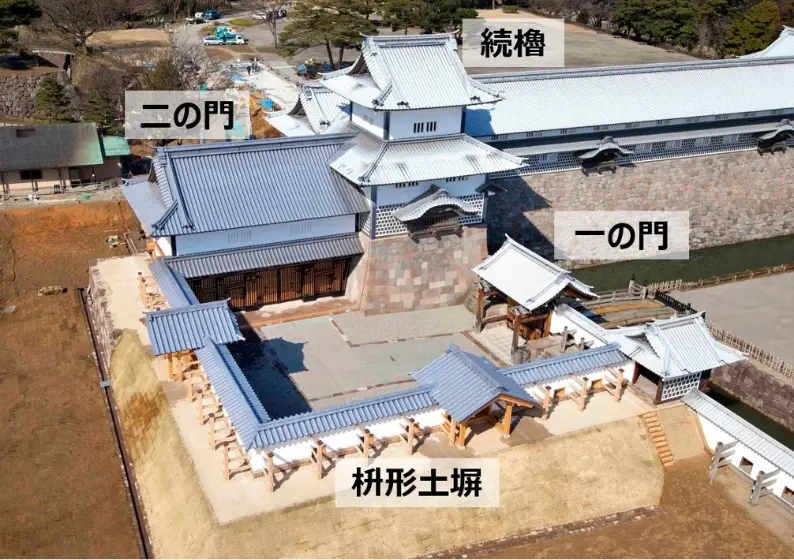
The gate complex is a masugata-style defensive structure consisting of Ichino-mon(the First Gate) in koraimon style, a square enclosure surrounded by stone walls and double earthen walls, and Nino-mon(the Second Gate) in yaguramon style.
The masugata area boasts the largest scale of any within the castle.
A guard station was located in Nino-mon(the Second Gate), and its floor was paved with Tomuro stone—the same stone used at the entrance of the Ninomaru Palace.
After being destroyed in the fire of 1808 (Bunka 5), the gate was rebuilt in 1809 (Bunka 6) and remained until the Meiji period.
However, in 1881 (Meiji 14), it was again lost to a fire accidentally caused by the Army, along with the Ninomaru Palace and Gojikken-nagaya Storehouse.
In 2001 (Heisei 13), Ichino-mon was reconstructed, followed in 2015 (Heisei 27) by the reconstruction of Nino-mon and the masugata double earthen walls—thus restoring the entire masugata gate complex.
As part of the restoration, an internal passage connecting Nino-mon to the interior of the Hashizume-mon Tsuzuki Turret was added, allowing visitors to enter from the turret side and view the interior of the restored structures.
The three major gates
Ishikawa-mon Gate, Kahoku-mon Gate and Hashizume-mon Gate are called “the three major gates of Kanazawa castle ”. They are the most important gates because they connect each area of Kanazawa castle. IIshikawa-mon Gate was reconstructed in 1788 after the big fire of 1759. It has been designated a nationally important cultural property.Kahoku-mon Gate was restored based on available documents in April 2010. Since the completion of Hashizume-mon Gate, all of the major gates of Kanazawa castle have been restored. It is now possible to view Sannomaru as it appeared in the later period of the Edo era.
Comparison of the three major gates
Second floor area
comparison of Nin-no mon |
Area comparison of Masugata |
|
①Ni-no mon of Kahoku mon…220㎡(26.9m×8.2m) |
①Kahoku mon…255㎡ |
|
②Ni-no mon of Ishikawa mon…181㎡(24.9m×7.3m) |
②Ishikawa mon…272㎡ |
|
③Ni-no mon of Hashizume mon…113㎡(14.4m×7.9m) |
③Hashizume mon…445㎡ |
※Referenced from designs and architectural plans
Dimension/Structure/Finishing process
Based on available drawings, old photographs, documents as well as findings from archaeological research, the restoration of the Hashizume-mon Gate was performed by respecting the historical facts as much as possible.
Outline of Buried Cultural Property Research
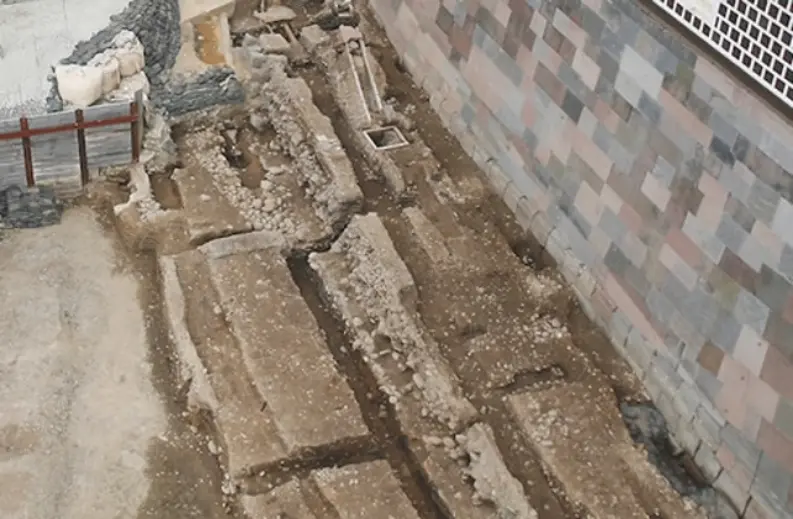
The consolidation of the peristyle foundation on the northern side of the Ni-no mon (the second gate), the closed conduit of the rock assembly and the platform of the stone wall were uncovered during excavation of the site.Inspection of the stone wall revealed traces of the original paving stones as well as the “nomikiri” (the center of the nailing post) of the Ni-no mon. These discoveries assisted in the restoration process by confirming the elevation of the paving stones and the bay size of Ni-No mon, which was rebuilt in 1809.

Consolidation of the foundation and the closed conduit of the rock assembly confirmed at the bottom of Tsuduki Yagura(watch tower)

Nomikiri, the center of the nailing post /Remains of paving stones
Outline of Drawings and Documentary Records
A large number of maps and drawings of Kanazawa Castle have been preserved, and these materials serve as essential references for its restoration work.
For the reconstruction of Hashizume-mon as well, multiple detailed plans and elevation drawings from the late Edo period were available, providing crucial evidence for the architectural design.
Historical documents—such as entries in the O-Zoeifō Hinnami-ki, written by Takabatake Atsusada, the construction magistrate during the Bunka-era reconstruction—were also used as key sources supporting the restoration.
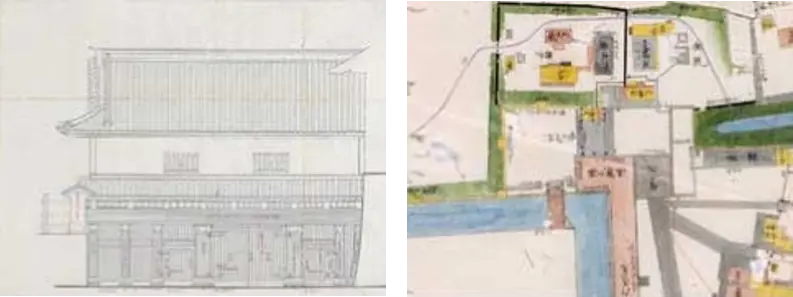
左:橋爪御門等御絵図-3. 橋爪二之御門図 (金沢市立玉川図書館蔵)右:御城中壱分碁絵図 (横山隆昭家蔵)