Reconstruction of Kanazawa Castle
Nezumita-mon Gate & Nezumita-mon-bashi Bridge
The "Nezumita-mon Gate," Known for Its Distinctive Black Namako-Plastered Walls, and the “Nezumita-mon-bashi Bridge,”
the Largest Wooden Bridge within the Castle Grounds
— Restored to Their Former Appearance for the First Time in About 140 Years Since Their Loss in the Meiji Era —
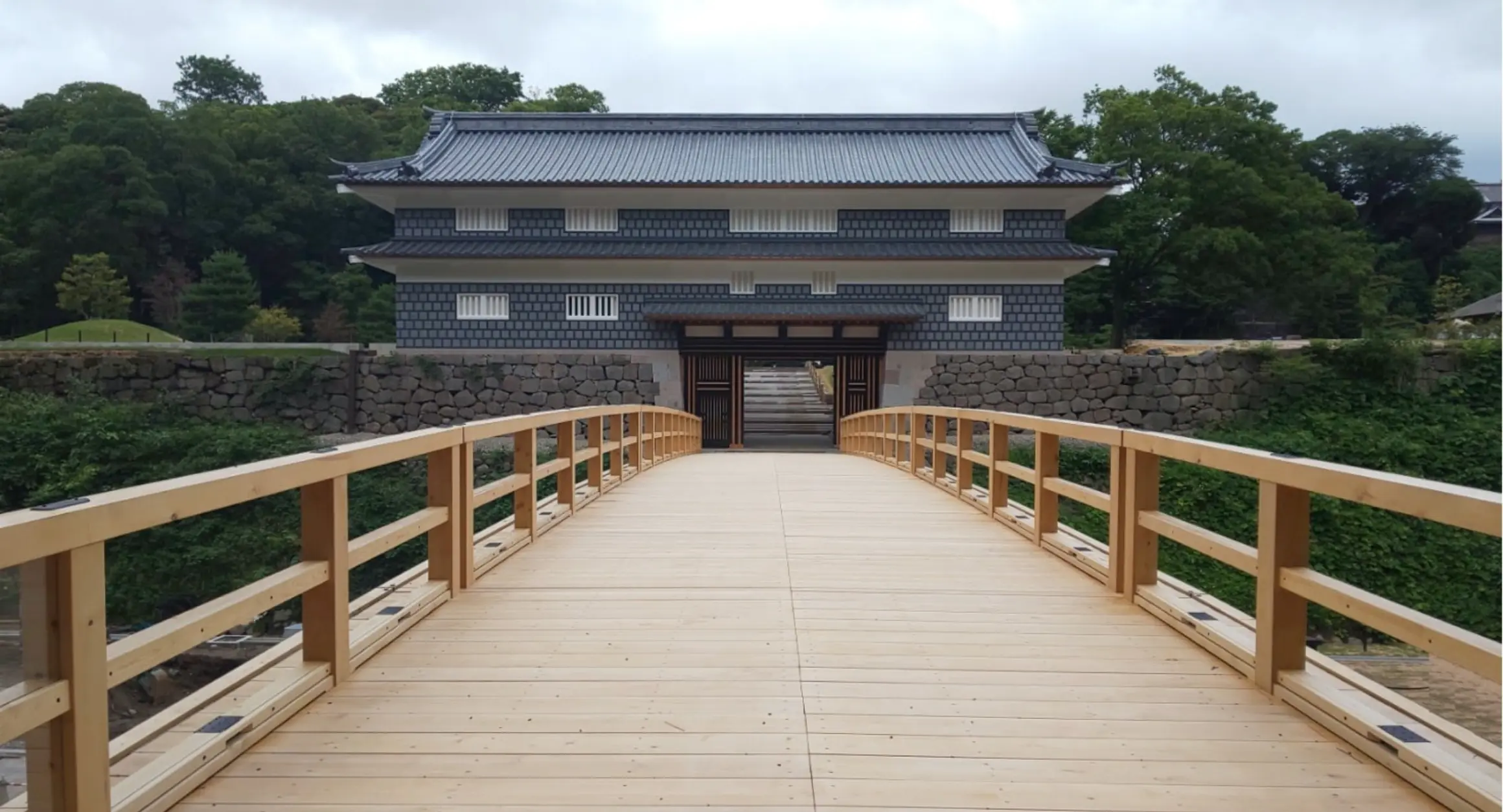
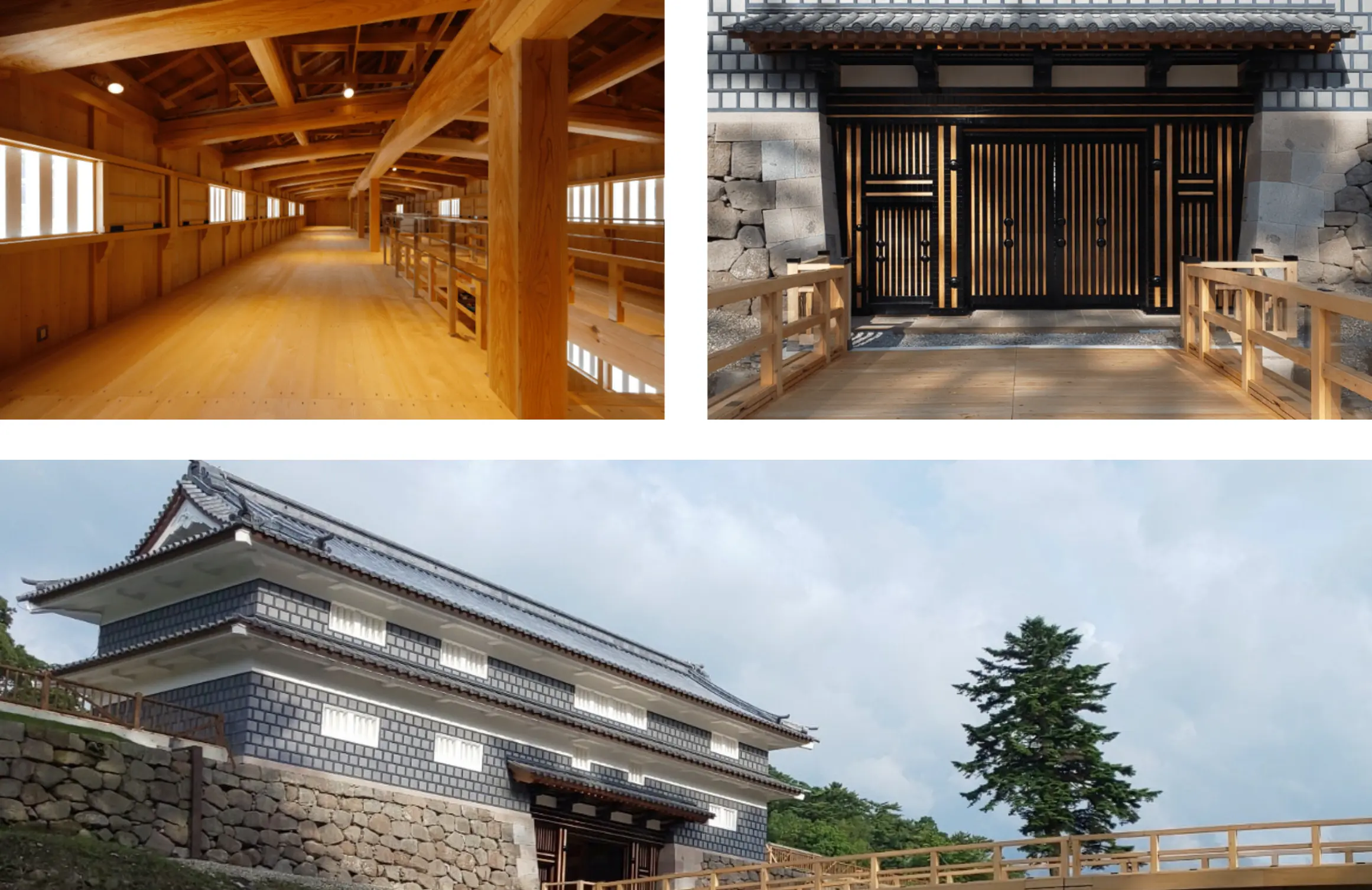
Characteristics and Overview of the Restoration of Nezumita-mon Gate and Bridge.
Nezumita-mon Gate is located along the exterior of the Gyokusen’inmaru, an enclosure in the western area of the Kanazawa Castle grounds. The gate stood at one end of the Nezumitamon Bridge, which led to the Kanaya Demaru area (today, the grounds of Oyama Jinja Shrine).
This castle gate features a turret above the doorway. It is unknown when, exactly, it was originally built, but old materials such as a map from the time indicate that it already existed by the early 17th century. The gate was spared from the 1759 fire that destroyed many of the buildings on the castle grounds, and kept maintained through the 19th century.
Much like the other gates on the castle grounds, the roof is covered with lead tiles, and the exterior walls are plastered in white above the namako tiling that extends much of the way up each wall. However, the plaster connecting the tiles here is black, rather than the usual white, for a distinctive appearance unlike any other gate on the castle grounds.
Nezumita-mon-bashi Bridge was one of the largest wooden bridges on the castle grounds, crossing over the water-filled moat between the Gyokusen’inmaru and Kanaya Demaru areas. It was rebuilt a number of times, and stood through the 19th century.
In 1877, Nezumita-mon-bashi Bridge was demolished due to age and wear, and in 1884, Nezumita-mon Gate was destroyed in a fire. Later, the surrounding moat was filled in, removing any vestige of these features from the castle.
Based on the results of archaeological excavations and studies of historical maps and documents, Nezumita-mon Gate was reconstructed in wood in accordance with historical accuracy, while Nezumita-mon-bashi Bridge was completed in 2020 (Reiwa 2) using a steel structure that meets modern safety standards, finished with wooden cladding to replicate its original appearance.
During the restoration work, protective soil layers were placed over Edo-period remains identified through excavation, and deteriorated stone materials were repaired, ensuring the reliable preservation of these cultural heritage assets.
Much like the other gates on the castle grounds, the roof is covered with lead tiles, and the exterior walls are plastered in white above the namako tiling that extends much of the way up each wall. However, the plaster connecting the tiles here is black, rather than the usual white, for a distinctive appearance unlike any other gate on the castle grounds.
Nezumita-mon-bashi Bridge was one of the largest wooden bridges on the castle grounds, crossing over the water-filled moat between the Gyokusen’inmaru and Kanaya Demaru areas. It was rebuilt a number of times, and stood through the 19th century.
In 1877, Nezumita-mon-bashi Bridge was demolished due to age and wear, and in 1884, Nezumita-mon Gate was destroyed in a fire. Later, the surrounding moat was filled in, removing any vestige of these features from the castle.
Based on the results of archaeological excavations and studies of historical maps and documents, Nezumita-mon Gate was reconstructed in wood in accordance with historical accuracy, while Nezumita-mon-bashi Bridge was completed in 2020 (Reiwa 2) using a steel structure that meets modern safety standards, finished with wooden cladding to replicate its original appearance.
During the restoration work, protective soil layers were placed over Edo-period remains identified through excavation, and deteriorated stone materials were repaired, ensuring the reliable preservation of these cultural heritage assets.
Overview of the Structures


Overview of Cultural Property Investigations
Archaeological excavations revealed the outer boundary line of Nezumita-mon Gate and identified the locations of its foundation stones.
The lower portions of the stone walls lining the passageway were also found to remain intact.
Through these findings, the remains of Nezumita-mon Gate—destroyed in 1884 (Meiji 17)—were confirmed, allowing its scale and structural characteristics to be accurately understood.
Fragments of namako‑shikkui (sea‑cucumber plaster), a distinctive feature of the gate, were also unearthed.
These remains revealed that the namako walls of Nezumita-mon Gate were finished in a dark, grayish‑black plaster.
During the investigation of Nezumita-mon-bashi Bridge, the remains of bridge piers dismantled in 1877 (Meiji 10) were detected, along with even earlier pier foundations.
These discoveries indicate that the bridge had undergone several rebuilds over its history.
Through these findings, the remains of Nezumita-mon Gate—destroyed in 1884 (Meiji 17)—were confirmed, allowing its scale and structural characteristics to be accurately understood.
Fragments of namako‑shikkui (sea‑cucumber plaster), a distinctive feature of the gate, were also unearthed.
These remains revealed that the namako walls of Nezumita-mon Gate were finished in a dark, grayish‑black plaster.
During the investigation of Nezumita-mon-bashi Bridge, the remains of bridge piers dismantled in 1877 (Meiji 10) were detected, along with even earlier pier foundations.
These discoveries indicate that the bridge had undergone several rebuilds over its history.



Chronology of Events Related to Nezumita-mon Gate and Nezumita-mon-bashi Bridge
|
1583 Tensho 11 |
Maeda Toshiie becomes the lord of Kanazawa Castle |
|---|---|
|
1623 Genwa 9 |
Gyokusen’in, the wife of Maeda Toshinaga (the second lord of the Kaga Domain) dies, and her residence is demolished; from this point on, the premises are known as the Gyokusen’inmaru |
|
1631 Kan'ei 8 |
Ni-no-Maru Palace is constructed |
|
1634 Kan'ei 11 |
A garden is constructed in the Gyokusen’inmaru |
|
1759 Houreki 9 |
A fire destroys the majority of the castle grounds, but Nezumitamon Gate remains intact |
|
1765 Meiwa 2 |
Nezumitamon Bridge is rebuilt |
|
1812 Bunka 9 |
Nezumitamon Nagaya is repaired |
|
1816 Bunka 13 |
Nezumitamon Gate is renamed to “Gyokusen’in-sama-maru Gomon” (“Gate of the Enclosure for Gyokusen’in”) |
|
1821 Bunsei 4 |
A new armor storehouse is constructed |
|
1871 Meiji 4 |
The feudal domain system is abolished, and the prefecture system is put in place; Kanazawa Castle is placed under military jurisdiction |
|
1873 Meiji 6 |
Oyama Jinja Shrine is constructed on the former site of the Kanaya Demaru |
|
1877 Meiji 10 |
Nezumitamon Bridge is demolished due to age and wear |
|
1881 Meiji 14 |
Ni-no-Maru Palace, in use at the time as a military headquarters, is destroyed in a fire |
|
1884 Meiji 17 |
Nezumitamon Gate is destroyed in a fire |
|
1932 Showa 7 |
The moat by Nezumitamon Gate is filled in and converted to a road |
|
1949 Showa 24 |
Kanazawa University is established |
|
2001 Heisei 13 |
Kanazawa Castle Park opens to the public |
|
2008 Heisei 20 |
The site of Kanazawa Castle is designated as a national historic site |
|
2015 Heisei 27 |
The reconstruction of Nezumitamon Gate and Nezumitamon Bridge is included in the Third Kanazawa Castle Park Development Project, and the Expert Committee on the Restoration of the Nezumitamon Gate and Other Structures of Kanazawa Castle is established |
|
2020 Reiwa 2 |
Nezumitamon Gate and Nezumitamon Bridge are completed in July |