Museum of stone walls

Natural Stacking Technique
A method in which natural stones or roughly split stones are stacked with minimal shaping. This style can be seen in some of the oldest stone walls, such as those around the Higashi‑no‑maru area.

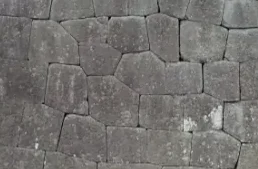
Rough Stone Stacking Technique
A technique that uses stones that have been further shaped after splitting to fit tightly together with little or no gaps. This method is often used in stone walls at important locations such as gates and entrances.
Cut Stone Stacking Technique
A technique in which stones are precisely shaped into rectangular blocks and stacked without gaps. Prioritizing appearance, it is used in areas that are highly visible, such as gates and gardens.
Changes Since the Meiji Period
Shikishitanzaku-zumi Stone Wall
The group of stone walls facing the Gyokusen’inmaru Garden includes finely crafted cut‑stone masonry designed as integral elements of the garden’s composition. Among them, the Shikishi‑tanzaku‑zumi stone wall is especially notable, as it incorporates a waterfall at its upper section—a highly distinctive feature.
At the mouth of the waterfall, a V‑shaped stone trough is installed, and square “shikishi‑shaped” stones along with rectangular “tanzaku‑shaped” Tomuro stones are arranged in a staggered pattern. This stone wall is regarded as a masterpiece unique to Kanazawa Castle, in which advanced castle‑wall masonry techniques and refined garden aesthetics are splendidly combined.
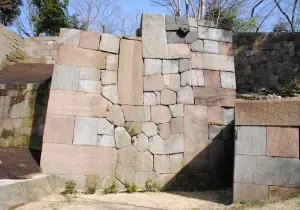
Ishikawa-mon Gate’s Stone Wall
The stone walls within the masugata (defensive courtyard) of Ishikawa Gate display two different masonry techniques in the same location: the front face of the masugata is built with fully Cut Stone Stacking Technique, while the left side is constructed using Rough Stone Stacking Technique. Large chiseling marks can be observed on the surfaces of the stones.

Sanjikken Nagaya’s Stone Wall
This wall employs a technique known as kaneba‑torinokoshi‑zumi, a variant of cut‑stone masonry in which only the outer edges of the stones are neatly finished while the inner surfaces are left rough.
On the west side of the stone wall, one can find artistically arranged stones, including perfectly hexagonal stones and vertically set stones.

Kikkō‑ishi of the Dobashi-mon Gate Stone Wall
The hexagonal stones known as kikkō‑ishi, incorporated into the Cut Stone Stacking Technique, symbolize turtles—animals associated with water—and were believed to express a wish for protection against fire.

Osaka-mon Gate’s Stone Wall
The stone walls of Osaka Gate, one of the main entrances of the castle, are constructed in kagami‑zumi style, which incorporates large stones known as kagami‑ishi (“mirror stones”). These are among the largest stones used in Kanazawa Castle and give the wall a dignified, imposing appearance.

Higashinomaru’s Northern Stone Wall
The stone walls throughout the Higashi‑no‑maru area are built using NaturalStacking Technique. These walls are precious remnants that convey the early appearance of Kanazawa Castle during the eras of Maeda Toshiie and Maeda Toshinaga.
