Reconstruction of the Kanazawa Castle’s Ninomaru Palace

最新情報

2025.9 Exhibits on the construction site fence
The temporary fence surrounding the palace construction site features displays introducing the reconstruction image of the Ninomaru Palace, reproductions of the Tiger Room’s wall paintings, and an overview of excavation of buried cultural properties. Beautiful decorative patterns of Karakami paper used on the palace’s sliding doors are also highlights worth seeing. When you visit the Ninomaru Plaza, please take a moment to enjoy these exhibits.
復元整備のあゆみAbout the Kanazawa Castle’s Ninomaru Palace
The Ninomaru Palace of Kanazawa Castle was the largest structure within the castle grounds, serving as both the residence of the feudal lord and the center of political administration. Covering an area of over 10,000 square meters and consisting of more than 60 rooms. It contained the "Omotemuki ,"used for ceremonies,the "Oimamawari ," where the feudal lord and the "Okumuki ," where the lord's family and female servants lived. The palace was built in these three sections.
The palace was a magnificent structure adorned with decorative metal fittings and paintings. Since its original construction in the early Edo period, it was destroyed twice by fire and rebuilt, remaining in existence until 1881.
Restoration of Kanazawa Castle’s Ninomaru Palace
The full version of this video (10 minutes) is being shown at the Tsuru-no-maru Rest House in Kanazawa Castle Park. It offers high-definition footage showcasing the origins of Kanazawa Castle, the layout of the palace buildings, and the exquisite interior designs, including wall paintings and decorative metal fittings.
To allow visitors to experience VR outdoors, we also provide a smartphone app. At designated VR viewing points within Kanazawa Castle Park, you can enjoy a virtual reconstruction of the Ninomaru Palace through your smartphone and immerse yourself in its original appearance.

Overview of the Reconstructed Building
Ishikawa Prefecture has been committed to authentic reconstruction efforts at Kanazawa Castle Park, a symbol of the region’s historical and cultural heritage. Beginning with the completion of the Hishi-Yagura Turret, Gojikken-nagaya Storehouse, and Hashizume-mon Tsuzuki-Yagura Turret in 2001, the project continued with the reconstruction of Kahoku-mon Gate, the second Hashizume-mon Gate, and, most recently, the Nezumita-mon Gate and Bridge in 2020, all carried out with a focus on historical accuracy.
Since 2018, extensive studies have been conducted in preparation for the reconstruction of the Ninomaru Palace, the central structure of Kanazawa Castle and the culmination of its overall reconstruction efforts. The reconstruction of the palace carries multifaceted significance: not only does it enhance the value and appeal of Kanazawa Castle, but it also ensures the transmission of traditional craftsmanship to future generations and contributes to rebuilding the livelihoods of artisans affected by the 2024 Noto Peninsula Earthquake.
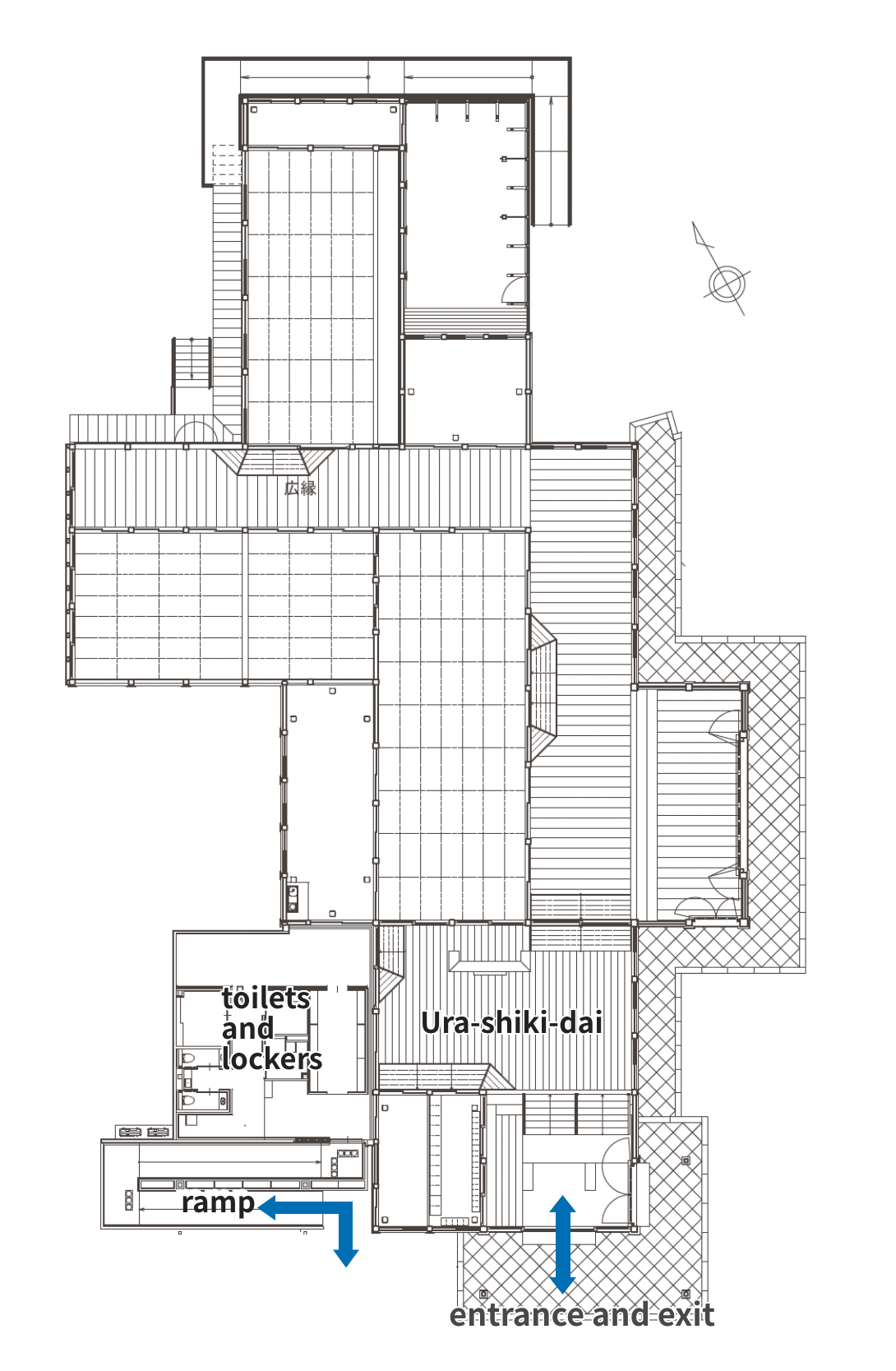
The reconstruction work focuses on the main sections of the “Omotemuki,” the formal area used for ceremonies , where the palace’s distinctive decorative features can be seen. In 2025, Phase 1 of reconstruction began, targeting the entrance and the surrounding Shikidai area.
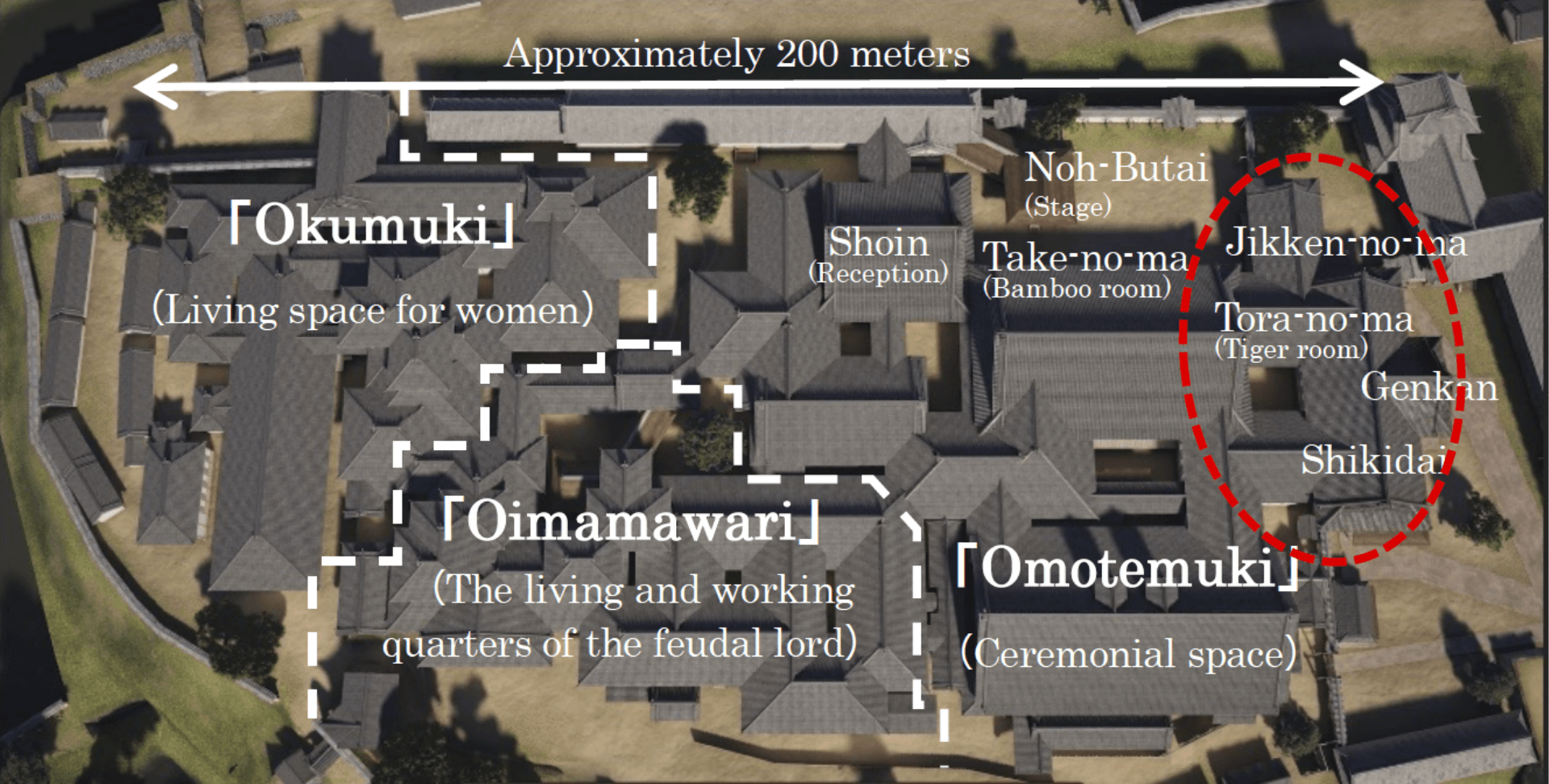
First, protective scaffolding and a temporary roof will be installed to cover the construction site, followed by the construction of the wooden structure of the palace itself, and then finishing work on the roof, interior, and exterior. Phase 1 of reconstruction is scheduled to be completed in fiscal year 2033.
Ninomaru palace is being reconstructed using traditional wood construction techniques, based on historical materials and archaeological excavation results.
At the same time, efforts are also being made to ensure safety and comfort for all visitors, including barrier-free accessibility, seismic reinforcement to protect against earthquakes, and air conditioning and heating.
Plan View

Genkan(Entrance)
The entrance was built entirely of zelkova wood, with the Maeda family’s Umebachi-mon crest attached to the exterior. Above the beam was a wooden carving depicting mythical rhinoceroses among waves, meant as a prayer for protection against fires a motif chosen based on the belief that these legendary beasts lived in the water.


Omote-shiki-dai
The Omote-shiki-dai was a large hall used to formally welcome guests.The walls and sliding doors were decorated with gold leaf and paintings of young pine trees, Iush with green needles, symbolizing everlasting prosperity.

Tora-no-ma
The Tora-no-ma(“tiger room”)served as a waiting room for ceremonies that were held in the large hall known as the Take-no-ma(“bamboo room”). It was named for its wall and sliding door paintings of tigers by Ganku, a painter who was originally from the Kaga Domain. It is said that the tiger motif was intended to imply that the lord was powerful enough to tame such fearsome beasts.
Jikken-no-ma
During its use as the Jikken-no-ma, the room served various purposes, including accommodating domain guards during ceremonies. In the restoration work, it will be developed as a space that can be utilized for lectures and cultural events.