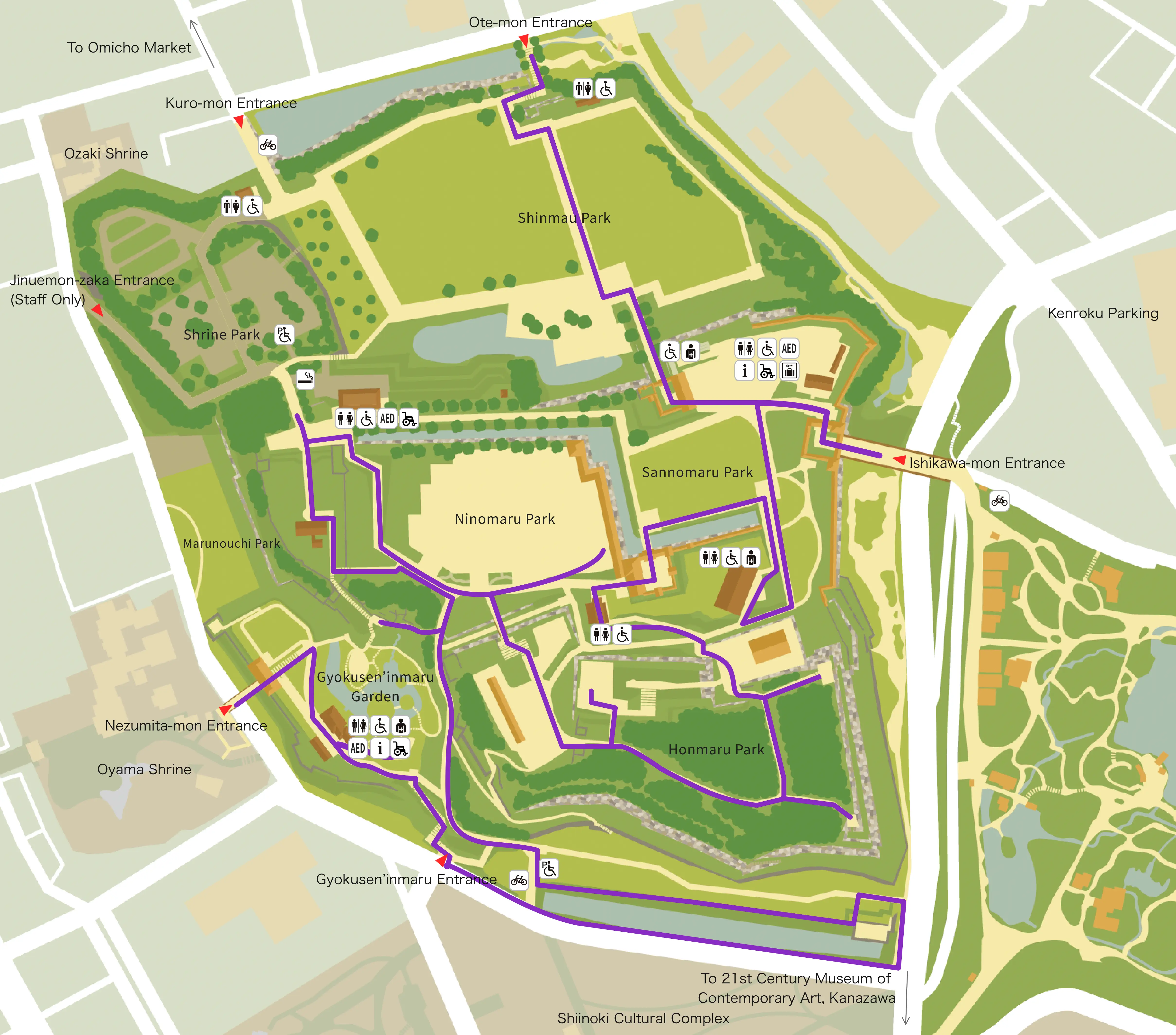
Highlights Map
Once you select a course, it will be displayed on the map.
For the stone wall tour course, please see here (PDF)
.
Leisurely Exploration Route (120min)
This is for people who want to enjoy Kanazawa Castle Park at their own pace.
 Restroom
 Accessible Restroom
 Ostomate Facilities
 AED
AED Information Center
 Wheelchair Rental
 Accessible Parking
 Bicycle Parking
 Coin Lockers
 Smoking Area
Ishikawa-mon Gate
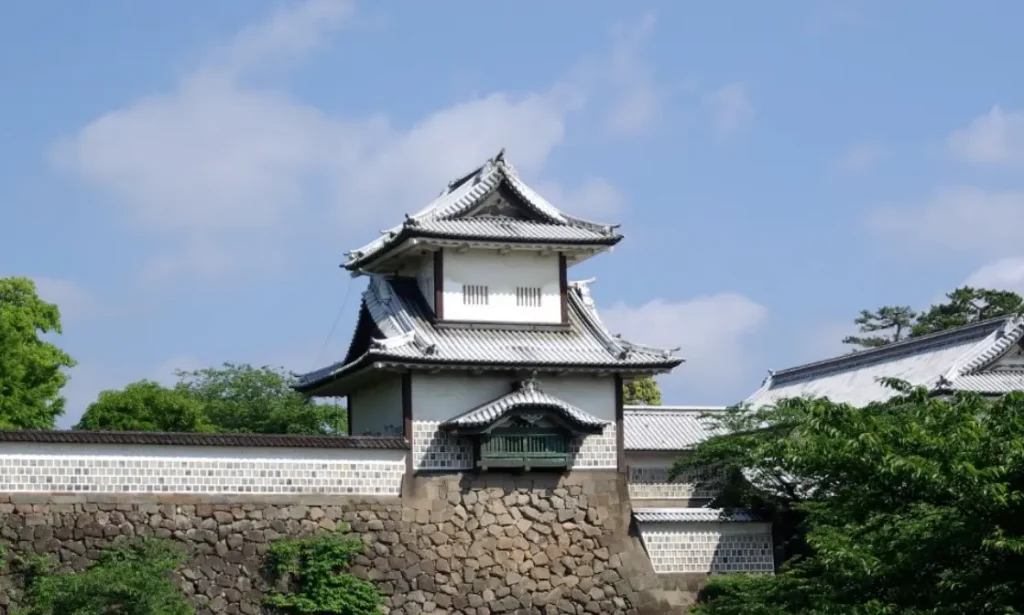
Ishikawa-mon gate has been designated as an Important National Cultural Asset. The present gate was reconstructed in 1788. It used to be the rear gate to Kanazawa Castle, and was constructed in a box-shape style to connect two turrets and two gatehouses.
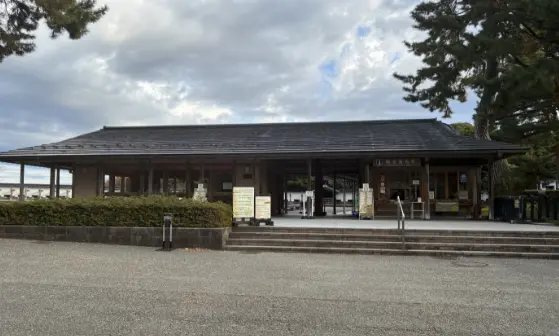
Entrance Rest Area・Information Booth
Kahoku-mon Gate
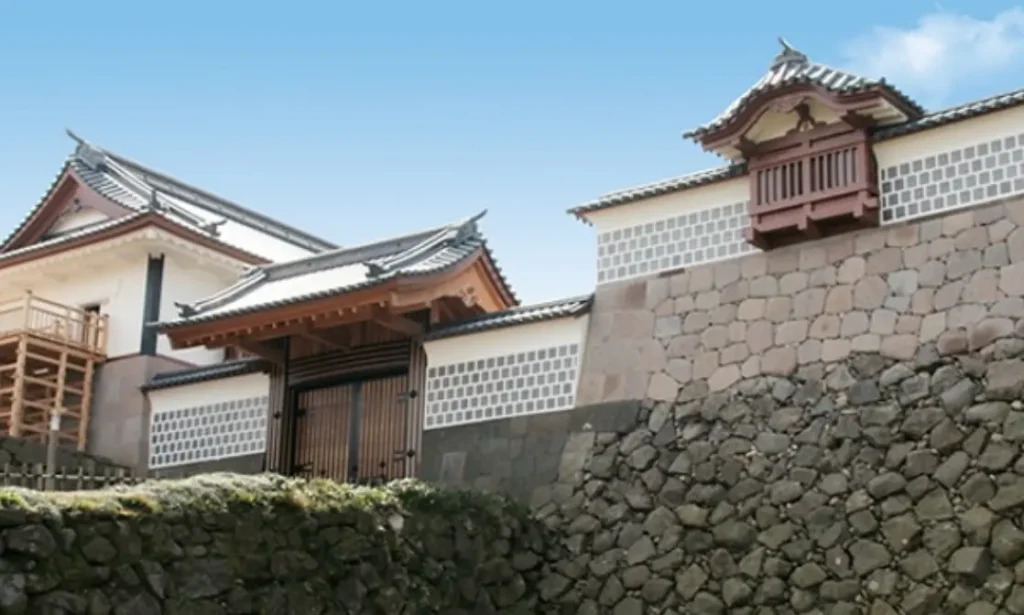
The Kahoku-mon gate, which is the "front face of the San-no Maru (the third enclosure)" and virtually the main gate of Kanazawa Castle, is located on the top of Kahoku-zaka Hill past the front castle gate. The Kahoku-mon gate is referred to as one of the three major gates of Kanazawa Castle, along with the Ishikawa-mon gate (listed as an important cultural asset of Japan) and the Hashizume-mon gate. After a major fire in 1759 consumed most of the Kanazawa Castle buildings, the Kahoku-mon gate was the first of the three major gates to be reconstructed, in 1772. This fact also shows the importance of the Kahoku-mon gate. After the reconstruction, the Kahoku-mon gate served as the main gate of Kanazawa Castle for practical purposes until it was demolished around 1880.
Tsurunomaru Rest House

Tsurumaru Storehouse

This is a mud-walled armory completed in the year 1848, during the late Edo period, and has been designated as Important National Cultural Asset along with Ishikawa-mon Gate and Sanjukken Nagaya. From the Meiji period onwards it was used for military clothing storage by the army. This has been called Tsurumaru Soko for a long time, but it was actually built as Higashi-no-maru Tsukedan. Designs are different to the watchtowers and castle gates, whitch can be seen in places such as at external walls with slates on them. This is one of the largest remains as a mud-walled store room in the castle area in Japan, and the total floor area for the 2 levels is 636m2 (excluding the lean-to part).
Ushitora-yagura Remains

The name comes from its location-"ushitora," or northeast, from Hon-maru, the central enclosure. The turret was a watchtower at Higashi-no-maru to guard Hon-maru, but it was destroyed by a large fire in 1759. It is now an observatory with a nice view over Kenrokuen, Mt. Tomuro, and Mt. Ioh.
Inui-yagura Remains
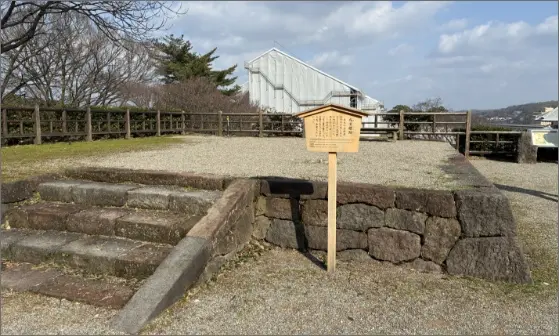
It was a two-story turret with bay windows on the west and north sides, but it was destroyed in the Great Fire of Hōreki (1759) and was never rebuilt afterward.
Tatsumi-yagura Remains

The area on the eastern side of Hon-maru was called ”Higashi-no-maru,” and the small area further down on the western side was called ”Hon-maru-fudan.” The remains of the Tatsumi Yagura and the Ushitora Yagura lie at Higashi-no-maru. In the Edo period, there was another watchtower called ”Naka Yagura” between these two yaguras. Therefore, three watchtowers, or yaguras, used to stand on a high stone wall facing the Hyakken Moat. Tasumi Yagura was one of the most distinctive watchtowers at Hon-maru. The Tatsumi Yagura lay to the south-east (called the ”tatsumi” direction in those days) of the donjon, the Ushitora Yagura to the north east (the ”ushitora” direction), and finally the Inui Yagura lay to the north-west (the ”inui” direction). These three watchtowers facing the Hyakken Moat”Tatsumi Yagura, Naka Yagura, and Ushitora Yagura”were designed to guard the Kodatsuno and Kenrokuen areas, which were believed to be the most vulnerable approaches to Kanazawa Castle. The Inui Yagura was used for surveillance of the whole castle, including the Ni-no-maru.
Hashizume-mon Gate

As the official main gate of the outer wall, Hashizume Gate is deemed the highest status among gates. It is composed of two parts. The outer entrance gate is in the korai-mon style, and the inner gate holds a masugata (rectangular space) and gatehouse, which is further enclosed by stone walls and a double mote. Together with the still-standing Ishikawa Gate and the restored Kahoku Gate, it is one of the three main gates of Kanazawa Castle, and the guardhouse located within the second gate is the largest on castle grounds. While the gate was originally lost to fire in 1881, its outer gate was restored in 2001, and its inner gate was restored in March 2015, together with its masugata area and double mote.
Hashizume-mon Tsuzuki-yagura Turret

This building stood looking down ”the Hashizume-ichi-no-mon gate,” the main gate to Ni-no-maru, the second enclosure. It was a very important watchtower for the surveillance of people going from San-no-maru to Ni-no-maru through Hashizume Bridge and the Hahizume-ichi-no-mon gate. The connecting hole in the center of the building was used to move weapons and food to the second floor. The Hashizume-mon gate was built in the ”masugata” style, just like the Ishikawa-mon gate.
Gojikken-nagaya Storehouse
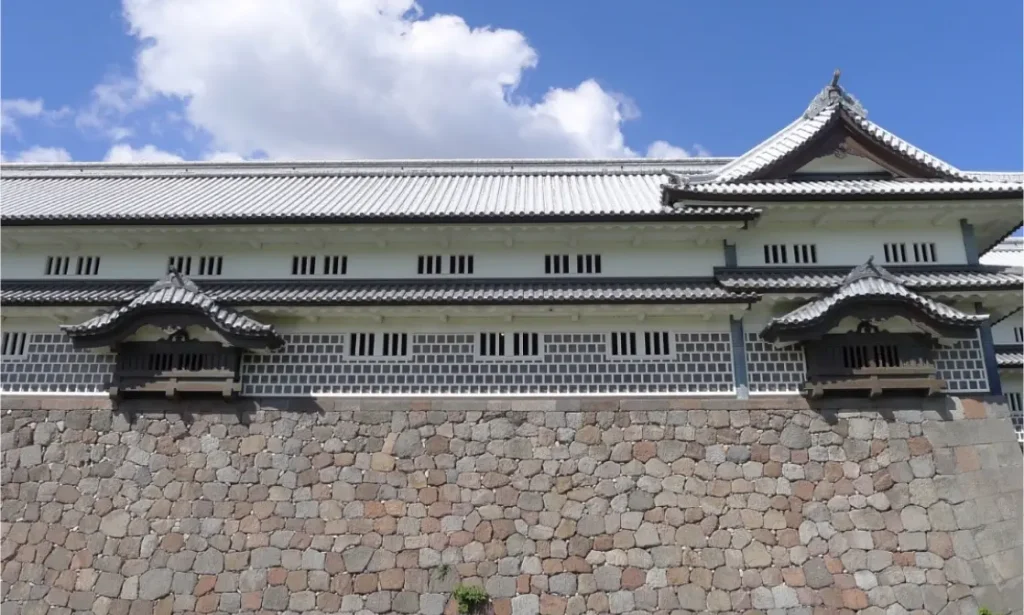
Gojukken Nagaya, which is connected to Hishi Yagura, was used as storage for weapons and other tools. If you go up to the second floor of the reconstructed building, you can see its architectural structures easily, such as the big pine beams and wooden joints. This building has two ”ishi-otoshi,” or stone-dropping slots. This kind of building design is called a ”tamon”-yagura, which means ” yagura with a long house structure constructed on a stone wall or an earthen mound. The name ”tamon yagura” comes from ”tamon-yama” Castle, which Matsunaga Hisahide constructed in 1560. At this castle, he had a yagura, a watchtower, where he worshipped the Tamon-ten Protective God.
Hishi-yagura Turret

Hishi Yagura, or Diamond Turret, is a three-story building, the sides of which are in a ”hishi”, or diamond shape, with angles of 80 and 100 degrees. It was the tallest building in Ni-no-maru, the second enclosure, and was the symbolic building in Kanazawa Castle, distinguished by its smart defense system called ”ishi-otoshi”, or stone-dropping, and its gorgeous appearance. Another feature of this building is its lead roof tiles. These tiles are 1.8 millimeters thick, and made of lead mixed with a little copper. Finally, the outside of this wall is called ”Namako Kabe,” or the Sea Cucumber wall. It is made by attaching flat tiles to the earthen wall with plaster.
Gokuraku-bashi Bridge

This bridge is located between Ni-no-maru and Hon-maru-fudan(where Sanjukken Nagaya is located). Reportedly, people visiting Kanazawa Mido used to cross this bridge chanting a prayer to the Buddha in the morning, and in the evening, they prayed to the sun setting in the Japan Sea, wishing to die a gentle and easy death. This was a simple wooden bridge with ”giboshi” decorations, and it was fully repaired in this project.
Sanjikken-nagaya Storehouse
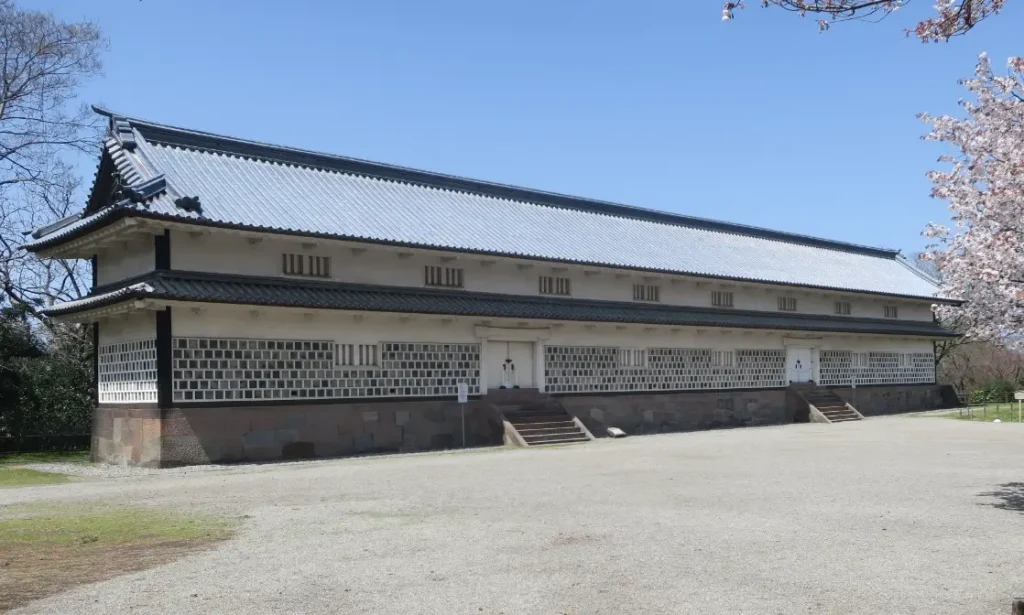
This two-story turret is an Important National Cultural Asset together with the Ishikawa-mon gate. It was constructed in 1858, and it is approximately 50 meters long. It is constructed on a stone wall made in a sophisticated "Kirikomi-hagi" style, it has "Namako Kabe," or the Sea Cucumber wall, and the roof is covered with lead tiles.
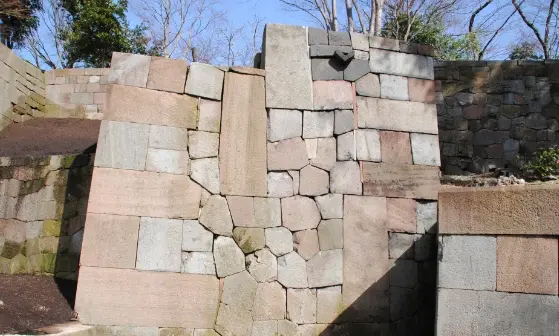
Shikishitanzaku-zumi Stone Wall
Nezumita-mon Gate & Bridge

Nezumitamon Gate, the gate on the west side of Kanazawa Castle with distinctive black namako-kabe plaster, has been restored in its original form for the first time since it burned down in the Meiji era 136 years ago. In addition, the Nezumitamon Bridge, which used to connect Nezumitamon Gate to Kanaya Demaru, has also been restored in its original location for the first time in 143 years.
Gyokusen’inmaru Garden and Gyokusen-an Rest Area

Gyokusen-an Rest Area is a rest area adjacent to the Gyokusen’inmaru Garden, where visitors can enjoy a lounge with a panoramic view of the garden and use the information desk. In the Japanese-style room, you can savor matcha along with original seasonal wagashi (traditional Japanese sweets).
Former 6th Brigade Headquarter

This is a one-story wooden building (floor area 196 square meters) built in 1898. At that time, because the army ministry designed all brigade buildings, similar constructions were built all over Japan. This building was used as the Education Expansion Center when the site was the main campus of Kanazawa University.
Uchi-bori Moat
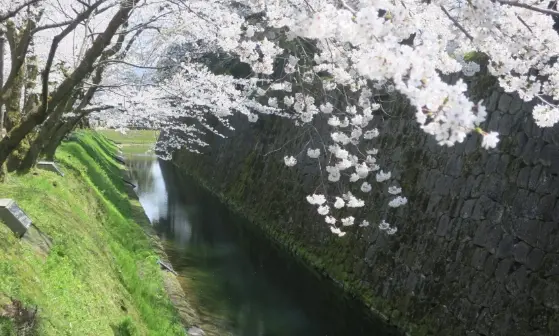
In order to reconstruct the inside moat, we have made large repairs to the stone wall, which functioned as the foundations of the Hishi Yagura and other buildings. This stone wall, which is 11.7 meters tall, had been severely eroded after many years and repeated fires. We removed the damaged parts (1200 square meters, 3766 stones), and rebuilt this stone wall with 3108 reused stones and 658 new stones.
Shissei-en (Wetland Garden)

This garden was constructed according to old drawings from the later Edo period and the results of excavational examinations for cultural assets'. The design of its bank was based on how the Shin-maru Minami moat looked from the outside in those days. In this water garden, which has an atmosphere of old moats, you can enjoy various wetland plants, such as Japanese iris and water lilies.
Kuro-mon Entrance
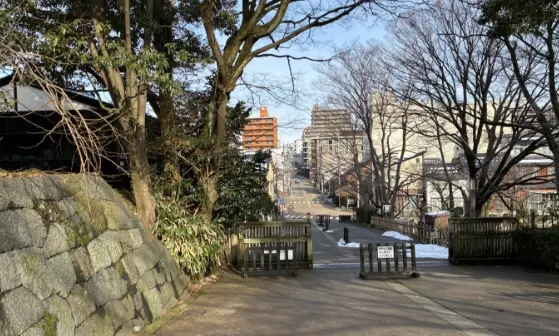
This used to be called ”the Nishicho-guchi-mon gate”, and was the front gate when Kanazawa Mido, a religious school, was located here. It remained as the front gate while Sakuma Morimasa occupied the castle, but when the Maeda Family became the castle owners, the front gate moved to the Osaka-mon gate. Later, in the Meiji period, the Nishicho-guchi-mon gate was re-named the Kuro-mon gate.
Ote-mon Gate(Osaka-mon Gate)
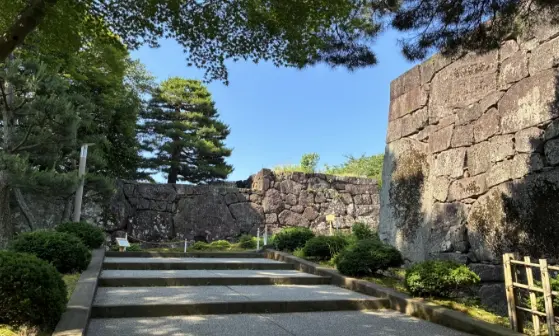
”Ote-mon” literally means the front gate. When the castle was under Sakuma Morimasaユs control, the Nishicho-guchi-mon gate (now called the Kuro-mon gate) was its front gate. After Maeda Toshiie entered the castle, the Osaka-mon gate became the front gate and this is what we now call the Ote-mon gate. This gate was built in the ”masugata”-style, too, and it was equipped with one of the biggest foundations for a watchtower at the castle. However, as far as we know from old records and drawings of the age, there is no evidence that this foundation ever actually had a watchtower on it.
Ote-bori Moat
Imori-bori Park

The Imori moat was once an outer moat surrounding the southwest part of Kanazawa Castle. In 1907, however, the upper part of the moat was flattened and the moat reclaimed by the Imperial Japanese Army. The site then served as army land, and, after World War II, as tennis courts. During the Edo period, the moat spanned some 40 meters at its widest portions, had a depth of more than 10 meters, and was filled with water. Its tamped slopes inclined at a relatively gentle gradient, and the stone walls of the Riko Yaguradai watchtower rose to form its southeastern limit.
Riko-yagura-dai Platform
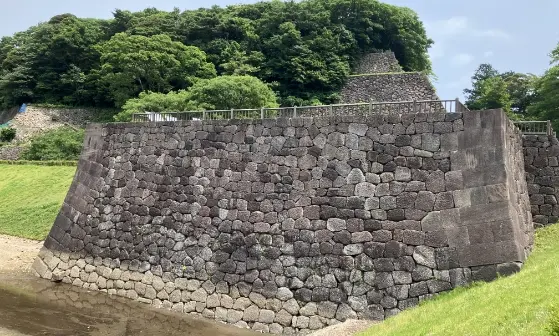
The stone wall of Riko-yagura-dai Platform was praised as “the finest stone wall within the castle grounds” by Goto Hikosaburo, a renowned Anō stonemason of the Kaga Domain. Although the upper structure was removed during the Meiji era, it was restored in 2010 along with the Imori-bori Moat. Today, it serves as a scenic viewpoint where visitors can enjoy panoramic views of the main enclosure’s stone walls and the Imori-bori Park.
Stone Wall Visitors Route
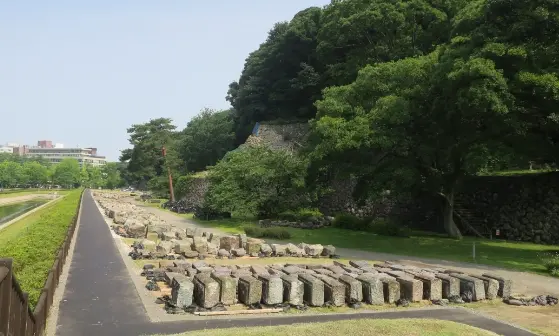
As part of the restoration work for the stone walls damaged by the 2024 Noto Peninsula Earthquake, stones removed from the walls have been gathered here. Along the walking path, you can see, touch, and learn about the stone materials, gaining a deeper understanding of the stone walls of Kanazawa Castle.
Dobashi-mon Stone Wall

Two stone walls remain on the east and west sides of the Dobashimon Gate, using a technique called "kiri-ishi-zumi,'' in which carefully processed stones are piled up without gaps. The stone wall on the east side has regular hexagonal stone called a "kikko-ishi("turtle stone"). This is a image of a turtle that associated with water, and is a protective charm against fire.
Park Management Office